

Search is no longer limited to a page of ten blue links. People now ask longer questions, compare options inside AI-generated results, continue with follow-up prompts, and expect useful answers without repeating their context. For website owners, this shift creates a new visibility challenge: your pages must still rank in traditional results, but they should also be clear, trustworthy, and useful enough to support AI-powered search experiences.
AI search optimization is sometimes called answer engine optimization, generative engine optimization, or AI SEO. A strong strategy still starts with crawlable pages, accurate information, original content, logical site architecture, and a satisfying user experience. The difference is that shallow keyword pages are becoming easier to ignore, while detailed pages that answer real questions and demonstrate first-hand knowledge have more ways to be discovered.
This guide explains how to optimize a website for AI search in 2026 without chasing shortcuts. It focuses on practical changes that publishers, small businesses, marketers, and WordPress site owners can apply to existing content.
What AI Search Optimization Really Means in 2026
AI search optimization is the process of making your website understandable, accessible, and genuinely useful across traditional search results and generative search features. It is not about writing robotic summaries for machines. It is about publishing content that can be confidently interpreted because the page has a clear purpose, reliable details, strong structure, and enough context to answer specific questions.
Google’s official guidance continues to emphasize valuable, unique, non-commodity content, solid technical SEO, and established search best practices. That matters because AI-powered results do not remove the need for indexing, relevance, quality, and usability. A page cannot become a dependable source when search systems cannot crawl it, understand its subject, or distinguish its main content from distractions.
Traditional SEO Still Provides the Foundation
Do not abandon standard SEO in an attempt to optimize for AI. Start with a focused page title, a descriptive URL, one clear H1, useful subheadings, internal links, optimized media, and content that satisfies the visitor’s actual intent. Make sure the page returns a successful status code, is indexable, works on mobile devices, and loads without unnecessary friction.
Keyword research also remains useful, but it should reveal questions and decision points rather than dictate repetitive wording. A person searching for “best project management tool” may really need to know which tool fits a five-person agency, supports client approvals, integrates with an existing calendar, and stays within a specific monthly budget. Content that addresses those conditions is more useful than a generic list of twenty products.
Build Every Page Around a Clear Search Intent
Choose one primary job for each page. A guide should teach, a comparison should help the reader choose, a review should evaluate a product, and a category page should organize related resources. Mixing several unrelated goals makes the page harder for visitors and search systems to interpret.
Before writing, define the audience, problem, desired outcome, and next question. For example, a beginner’s article about AI agents should explain what an agent is, where it can help, what access it needs, and what risks require human review. A more advanced article can focus on architecture, evaluations, or tool orchestration. Separating these intents produces clearer pages and stronger internal linking. Readers who need implementation ideas can then continue to our planned guide on AI agents for small business.
Make the Page Easy to Crawl and Understand
Use descriptive anchor text, logical navigation, and internal links that connect related ideas. Important pages should not be hidden behind search boxes, scripts, or isolated landing pages. Add meaningful alt text to informative images, compress large files, and avoid placing essential explanations only inside graphics or videos.
Structured data can help search engines identify eligible content types, but markup is not a replacement for visible content. The information in your schema should match what a visitor can read on the page. Use supported markup accurately and avoid adding types simply because they sound relevant. Clean HTML, clear headings, and consistent terminology are often more valuable than a complicated collection of unnecessary properties.
AI Systems Need Distinctive Information, Not Rewritten Consensus
Many websites publish the same definitions, features, and recommendations using slightly different wording. That creates commodity content: pages that add little beyond what already exists. AI search increases the pressure to contribute something distinct because generic summaries can be produced without visiting another repetitive article.
Your advantage is evidence. Include first-hand observations, screenshots, original examples, test conditions, limitations, pricing checks, workflow diagrams, comparison criteria, and explanations of why a recommendation fits one user but not another. A software review becomes more useful when it states what was tested, which plan was used, how long setup took, where the product failed, and who should avoid it.
Publish Original Evidence, Examples, and Comparisons
Create a repeatable editorial process. For a tool review, record the version or plan tested, testing date, use case, device, integrations, major strengths, limitations, and final recommendation. For a tutorial, verify every step on a clean setup and note where interfaces may differ. A comparison, use the same criteria for every option instead of praising each product with unrelated marketing claims.
Originality does not require expensive studies. A small business can publish anonymized workflow lessons, before-and-after performance results, common customer questions, or a transparent explanation of how it evaluates tools. A developer can document a migration, performance audit, security fix, or compatibility test. Our upcoming WordPress 7.1 readiness guide will use that practical approach by focusing on staging tests and compatibility rather than repeating a release announcement.
Accuracy also matters. Add visible publication and update dates when they are useful, correct outdated details, remove recommendations that no longer hold, and clearly separate facts from opinions. Do not create fake experience, fake authors, or unsupported test results. A confident tone cannot compensate for evidence that does not exist.
A Practical AI Search Optimization Workflow

Start with pages that already receive impressions, attract links, support conversions, or answer high-value customer questions. You do not need to rewrite the entire website at once. Improve a focused group of pages, track the outcome, and use what you learn to update your content standards.
First, review whether each page has a clear purpose and whether its opening paragraphs answer the main question directly. Next, identify missing decision details, examples, visuals, or proof. Then strengthen internal links so visitors can move naturally from awareness to comparison and action. Finally, check technical accessibility, mobile usability, and page speed before requesting reindexing where appropriate.
- Clarify the answer: State the main takeaway early, then add context and qualifications.
- Increase information gain: Add something readers cannot find in every competing article.
- Show your work: Explain testing methods, criteria, assumptions, and limitations.
- Improve media: Use original screenshots, diagrams, video, and accurate alt text when they help.
- Connect related pages: Build topic clusters with descriptive internal links rather than isolated posts.
- Review regularly: Update changing facts and preserve a clear record of meaningful revisions.
Security and trust also influence the overall experience. Protect author and administrator accounts, maintain software, and reduce avoidable risks that could compromise the site. Passwordless authentication is becoming increasingly relevant, which is why a future article will explain how passkeys can improve business website logins.
Measure Visibility, Engagement, and Business Value
AI search performance should not be judged by rankings alone. Monitor which pages gain impressions, which queries reveal new audience needs, how visitors engage after arriving, and whether the content contributes to leads, sales, downloads, product discovery, or other meaningful outcomes. A lower volume of highly qualified visits can be more valuable than a larger volume of unfocused traffic.
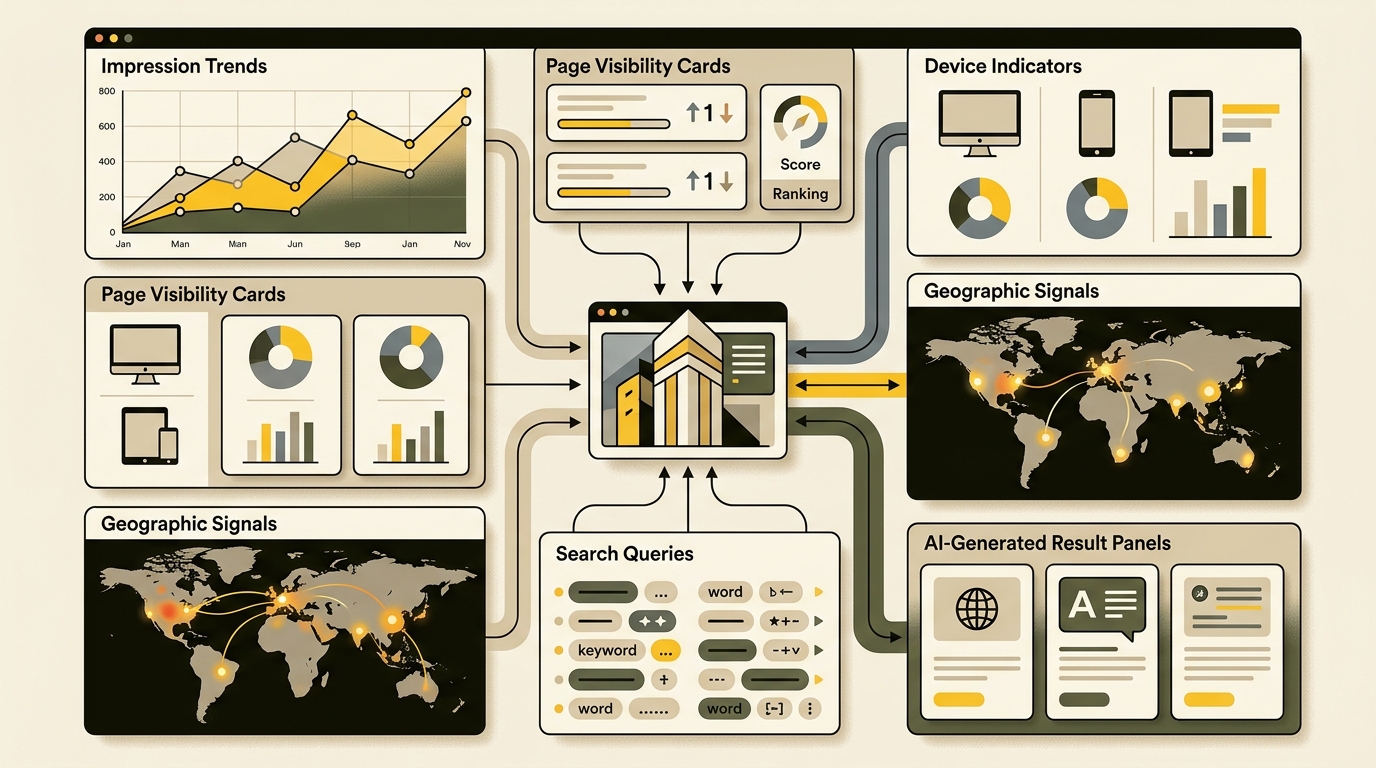
Google announced dedicated Search Console reporting for visibility in generative AI features, including information such as impressions, appearing pages, countries, devices, and performance over time. Use the reports available to your property rather than waiting for a perfect measurement system. You can review Google’s current recommendations in its official guide to generative AI features in Search.
Track Visibility Beyond Traditional Blue Links
Run a monthly review using Search Console, analytics, conversion data, and manual content checks. Look for pages appearing for detailed questions, comparison searches, and problem-solving queries. Watch whether branded searches increase after your content is cited, discussed, or shared elsewhere. Record major updates so performance changes can be connected to actual editorial work.
Avoid reporting invented “AI visibility scores” without understanding how they are produced. Third-party tools can provide useful directional data, but sampled prompts and changing outputs are not a complete record of every user experience. Use them as one signal alongside first-party search and business data.
The strongest AI search strategy is a publishing system that produces accessible pages, direct answers, trustworthy evidence, useful media, and connected expertise. Keep technical SEO healthy, but invest most heavily in information that deserves to be found. Websites that explain clearly, test honestly, and update responsibly will be better positioned as search interfaces continue to evolve.